Neural surrogates for the hardest flight regime
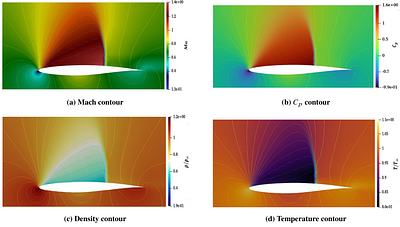
The transonic regime — where shock waves form and flow becomes exquisitely sensitive to geometry and Mach number — is among the most challenging domains in aerodynamics. This work trains artificial neural networks on OpenFOAM-generated data spanning a wide range of transonic conditions to predict airfoil aerodynamic coefficients near-instantly, replacing expensive RANS evaluations in early design.
The dataset behind it spans eight airfoils — RAE2822, RAE5212, and six NACA sections — swept across angle of attack and Mach number for 1,362 high-fidelity simulations with the density-based rhoCentralFoam solver, each resolving the shock structure over the airfoil in about seven minutes on 128 cores. On that foundation, the paper stages a fair fight between model families: random forests, gradient boosting, support vector machines, and neural networks, benchmarked head-to-head. The outcome — R² of 99.6% on unseen flow conditions — showed that even in the shock-dominated transonic regime, a well-trained surrogate can stand in for the solver at design-loop speeds. This early result seeded the lab's later, larger bet: that with enough high-quality data, learned models can carry real engineering workloads.
What the paper delivers
Transonic CFD dataset
1,362 high-fidelity simulations across eight airfoils — RAE2822, RAE5212, and six NACA sections — swept over angle of attack and Mach number with the density-based rhoCentralFoam solver, resolving the shock over each airfoil.
8 airfoils · AoA & Mach sweeps · ~7 min/case on 128 coresML model comparison
Neural networks benchmarked head-to-head against random forests, gradient boosting, and support vector machines — reaching R² of 99.6% on aerodynamic coefficients for unseen flow conditions.
R² = 99.6% on held-out conditionsOpen-sourced pipeline
Data generation and training code released for the community, with the full CFD dataset publicly available.
Code + dataset releasedCitation
@inproceedings{elrefaie2024transonic,
  title     = {Surrogate Modeling of the Aerodynamic Performance for
               Airfoils in Transonic Regime},
  author    = {Elrefaie, Mohamed and Ayman, Tarek and Elrefaie, Mayar and
               Sayed, Eman and Ayyad, Mahmoud and AbdelRahman, Mohamed M.},
  booktitle = {AIAA SCITECH 2024 Forum},
  doi       = {10.2514/6.2024-2220},
  year      = {2024}
}