The dataset that started the DrivAerNet ecosystem
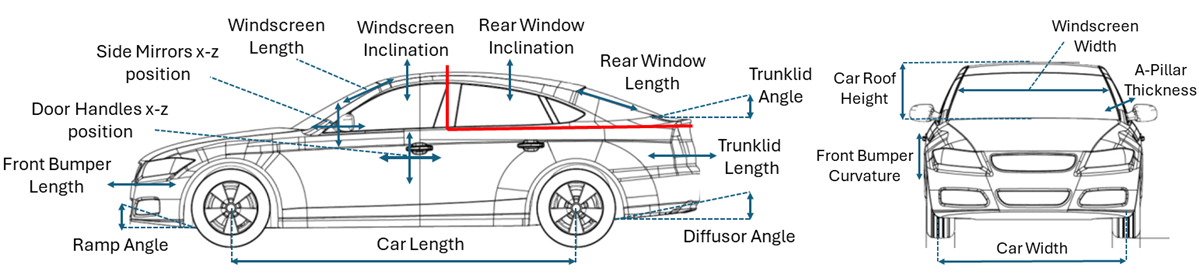
DrivAerNet introduced a large-scale, high-fidelity CFD dataset of 4,000 industry-standard car designs, each generated from a fully parametric model with 26 geometric parameters that completely describe the shape. It established the foundation for data-driven aerodynamic design at a scale the field previously lacked — and earned an ASME Papers of Distinction award at IDETC-CIE 2024, with an extended version published in the Journal of Mechanical Design.
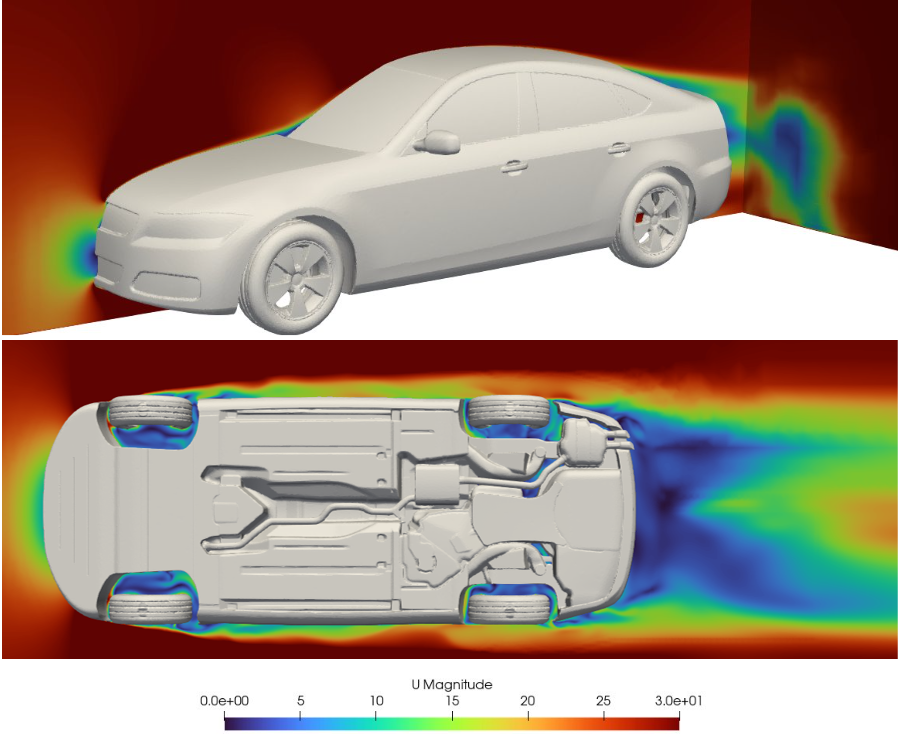
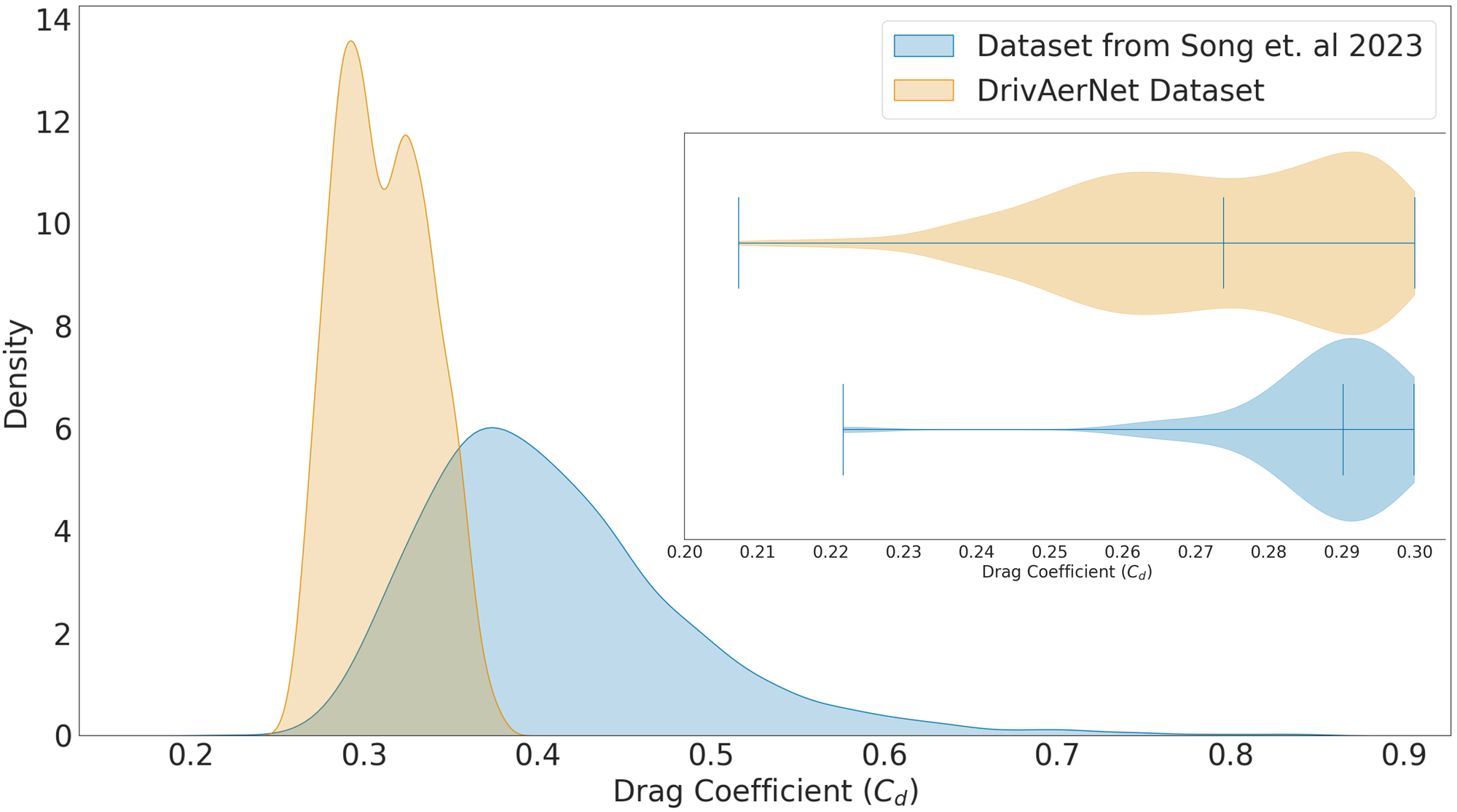
When this work began, the largest public car-aerodynamics dataset was substantially smaller — and none of the open alternatives modeled the parts that actually dominate real-world drag. DrivAerNet arrived 60% larger than the previously largest public dataset, and remains the only open-source one that resolves rotating wheels and the underbody. Each of the 4,000 designs carries half a million surface mesh faces and complete 3D pressure, velocity, and wall-shear-stress fields. On top of it sits RegDGCNN, a dynamic graph network that reads the raw 3D mesh directly — no 2D renderings, no signed-distance-field preprocessing — and returns a drag estimate in seconds, collapsing an overnight CFD loop into an interactive design tool.
What the paper delivers
Parametric, high-fidelity CFD at scale
Thousands of simulated DrivAer-family variants give ML models the breadth and fidelity needed to learn real aerodynamic structure instead of memorizing a handful of shapes.
4,000 designs · 26 parametersRegDGCNN drag surrogate
A dynamic graph convolutional network that regresses drag directly from 3D geometry — no parametric encoding, no meshing pipeline — enabling near-instant evaluation during design exploration.
Open-sourced training pipelineOpen benchmark protocol
Public train/validation/test splits and drag annotations turned the dataset into a reproducible benchmark adopted by the surrogate-modeling community.
Basis for DrivAerNet++ & CarBenchHigh-fidelity fields, not just drag numbers
Every simulation resolves the full 3D flow — rotating wheels, detailed underbody, mirrors — not simplified bodies. And because the designs are realistic production-style shapes, the drag-coefficient distribution concentrates in the industrially relevant range instead of scattering across implausible geometries.
From one paper to an ecosystem
DrivAerNet became the seed of a research line: DrivAerNet++ (NeurIPS 2024) scaled it to 8,150 multimodal designs, CarBench turned it into a community leaderboard, and integrations followed in NVIDIA PhysicsNeMo and Baidu PaddleScience.
Citation
@article{elrefaie2025drivaernet,
  title     = {DrivAerNet: A Parametric Car Dataset for Data-Driven
               Aerodynamic Design and Prediction},
  author    = {Elrefaie, Mohamed and Dai, Angela and Ahmed, Faez},
  journal   = {Journal of Mechanical Design},
  volume    = {147},
  number    = {4},
  year      = {2025},
  publisher = {American Society of Mechanical Engineers}
}

@proceedings{10.1115/DETC2024-143593,
  author = {Elrefaie, Mohamed and Dai, Angela and Ahmed, Faez},
  title  = {DrivAerNet: A Parametric Car Dataset for Data-Driven Aerodynamic
            Design and Graph-Based Drag Prediction},
  series = {IDETC-CIE},
  pages  = {V03AT03A019},
  year   = {2024},
  doi    = {10.1115/DETC2024-143593}
}