Taking the wind tunnel to the measurement, in real time
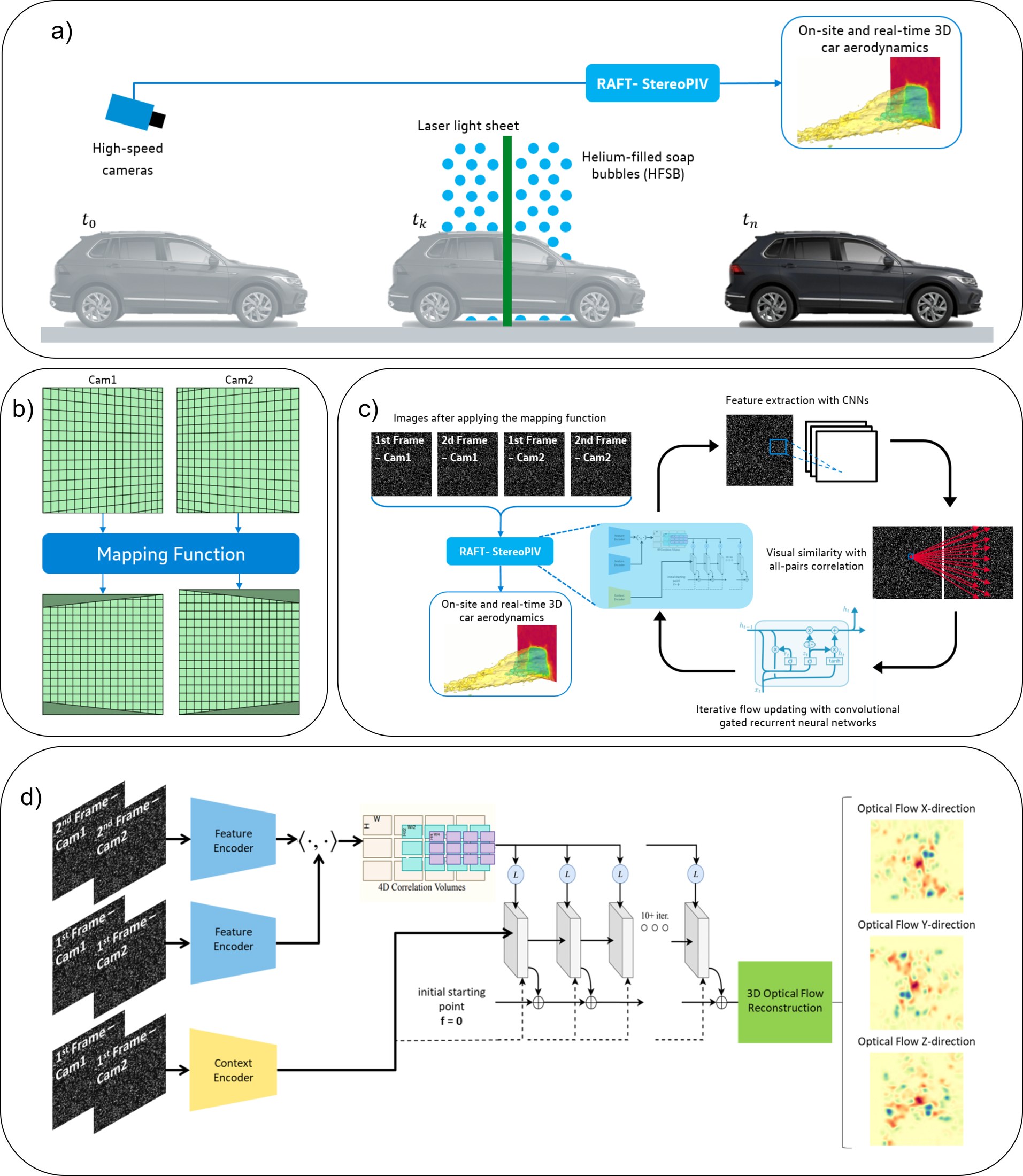
Particle image velocimetry is the gold standard for measuring flow fields — but classical cross-correlation processing keeps it offline and lab-bound. This work pairs stereoscopic PIV with deep optical-flow networks to deliver dense, three-component velocity fields in real time and on site, opening experimental aerodynamics to settings where conventional PIV processing is too slow.
The model, RAFT-StereoPIV, was trained on a multi-fidelity dataset spanning RANS and direct numerical simulation, and it earned its place the hard way: it outperformed every state-of-the-art deep-learning PIV model on the standard benchmarks, cutting error by 68% on the validation set and 47% on a fully unseen test class. Where earlier learning-based PIV stopped at 2D flows or synthetic data, this work pushes into three-dimensional, highly turbulent measurements from a real industrial campaign — and where classical cross-correlation returns a velocity field at roughly 16× lower resolution than the camera sees, the network keeps every pixel. It is a concrete step toward the field's long-term goal: measurement systems that estimate flow in real time, as the experiment happens.
What the paper delivers
Learning-based PIV processing
Deep optical-flow models estimate dense particle displacement fields directly from image pairs, replacing iterative cross-correlation.
Real-time stereoscopic pipeline
End-to-end processing fast enough for live, on-site measurement of three-component velocity fields.
Validated against classical PIV
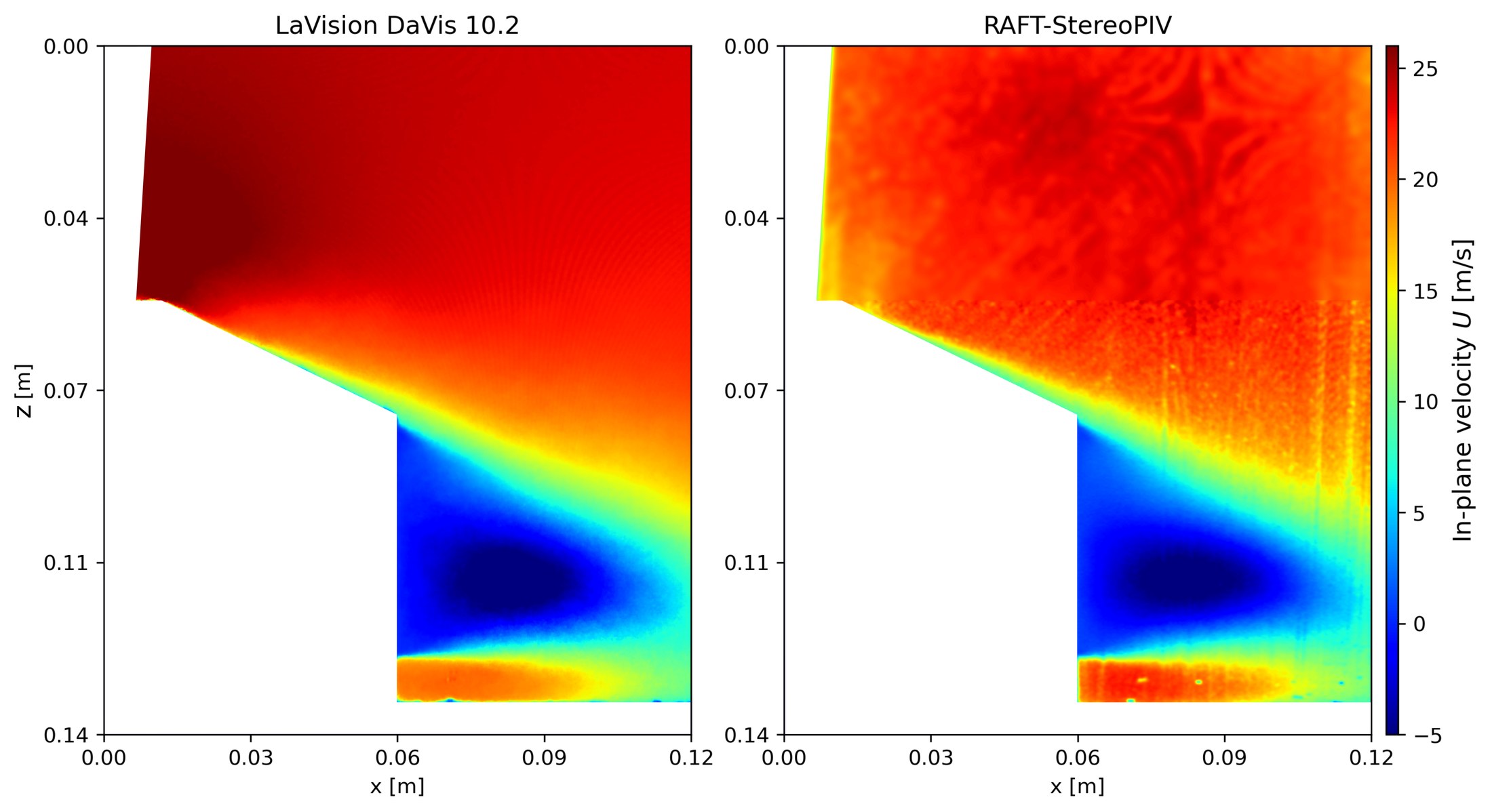
Accuracy benchmarked against state-of-the-art conventional processing, establishing trust in the learned estimates.
The "Ring of Fire", measured against the gold standard
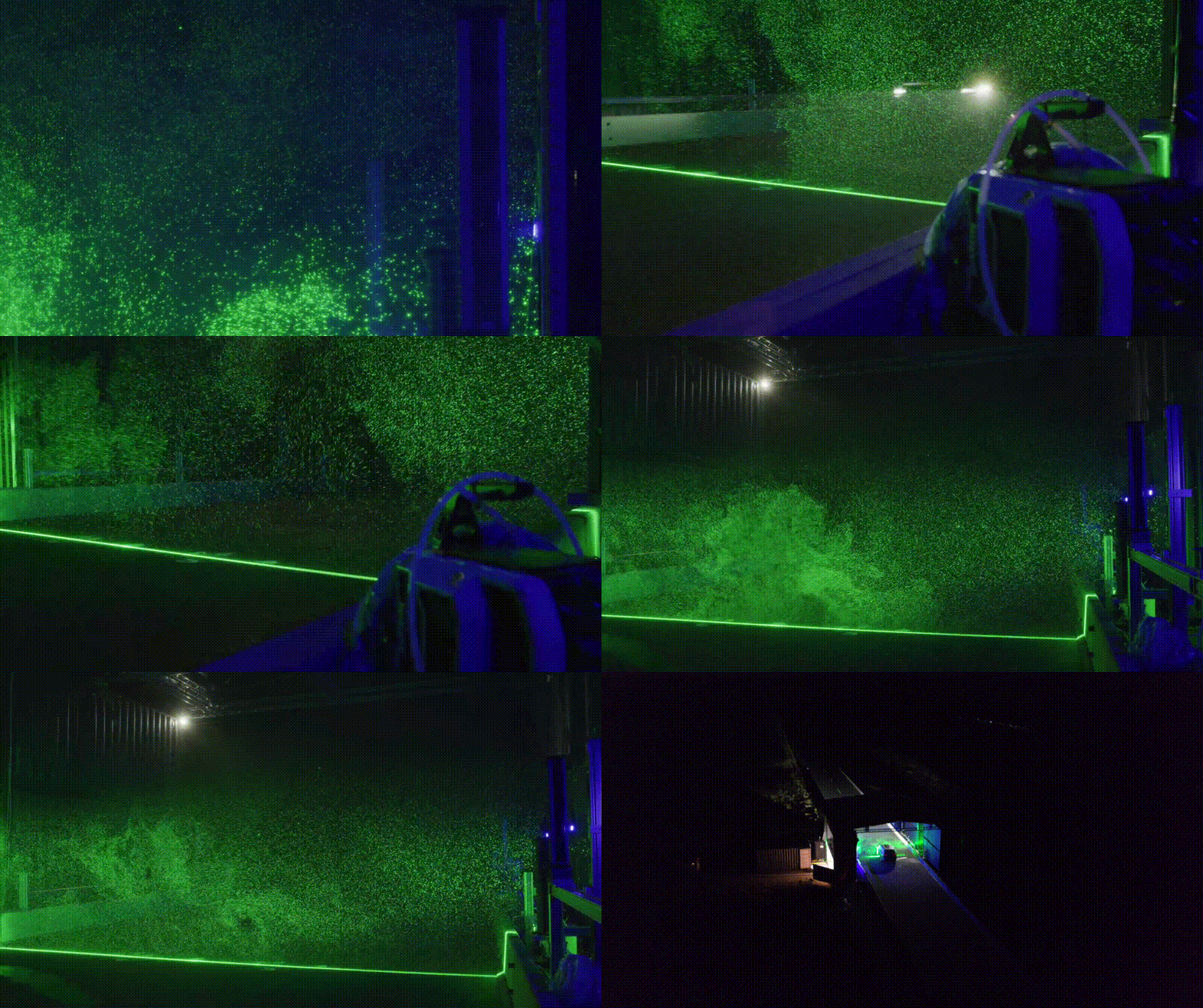
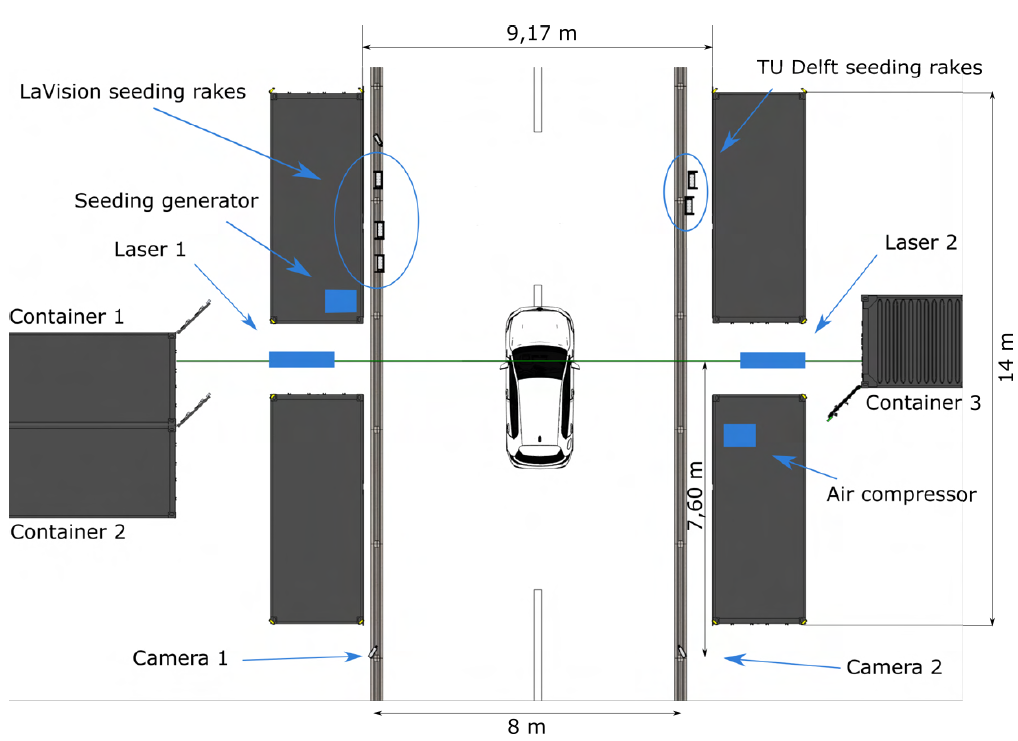
The on-site rig — dubbed the Ring of Fire — stations lasers, seeding rakes, and high-speed cameras along a track so a real car can drive straight through the measurement plane. On wake benchmarks, the learned estimator reproduces the flow topology of the commercial LaVision DaVis reference while running orders of magnitude faster.
Citation
@article{elrefaie2024piv,
  title   = {Real-time and on-site aerodynamics using stereoscopic PIV
             and deep optical flow learning},
  author  = {Elrefaie, Mohamed and H{\"u}ttig, Steffen and Gladkova, Mariia and
             Gericke, Timo and Cremers, Daniel and Breitsamter, Christian},
  journal = {Experiments in Fluids},
  volume  = {65},
  year    = {2024},
  publisher = {Springer Nature}
}