The largest public dataset for aerodynamic car design
DrivAerNet++ comprises 8,150 diverse car designs simulated with high-fidelity computational fluid dynamics, spanning fastback, notchback, and estateback configurations — with underbody and wheel variants representing both combustion and electric vehicles. Generated on MIT SuperCloud across 60 nodes and 2,880 CPU cores, it is the largest and most comprehensive resource of its kind for data-driven aerodynamic design.
The story starts with a bottleneck: deep learning transformed vision and language because those fields had massive public datasets — engineering never got one. A single high-fidelity car simulation takes roughly a day on hundreds of cores, so no lab could afford the data needed to train serious models. DrivAerNet++ absorbs that cost once, for everyone: three million CPU-hours of simulation, condensed into 39 TB of open data. Every entry carries detailed 3D meshes, a parametric description, aerodynamic coefficients, full flow and surface fields, segmented parts, and point clouds — so the same dataset serves design optimization, generative modeling, surrogate training, simulation acceleration, and geometric classification without a single new CFD run.
Every conventional car shape, parametrized
Each 3D geometry is fully described by 26 design parameters chosen for their aerodynamic impact, with ranges constrained to manufacturable, aesthetically plausible designs. This breadth lets models generalize, supports exploration of unconventional designs, and exposes how geometric features drive aerodynamic performance.
One car, ten representations
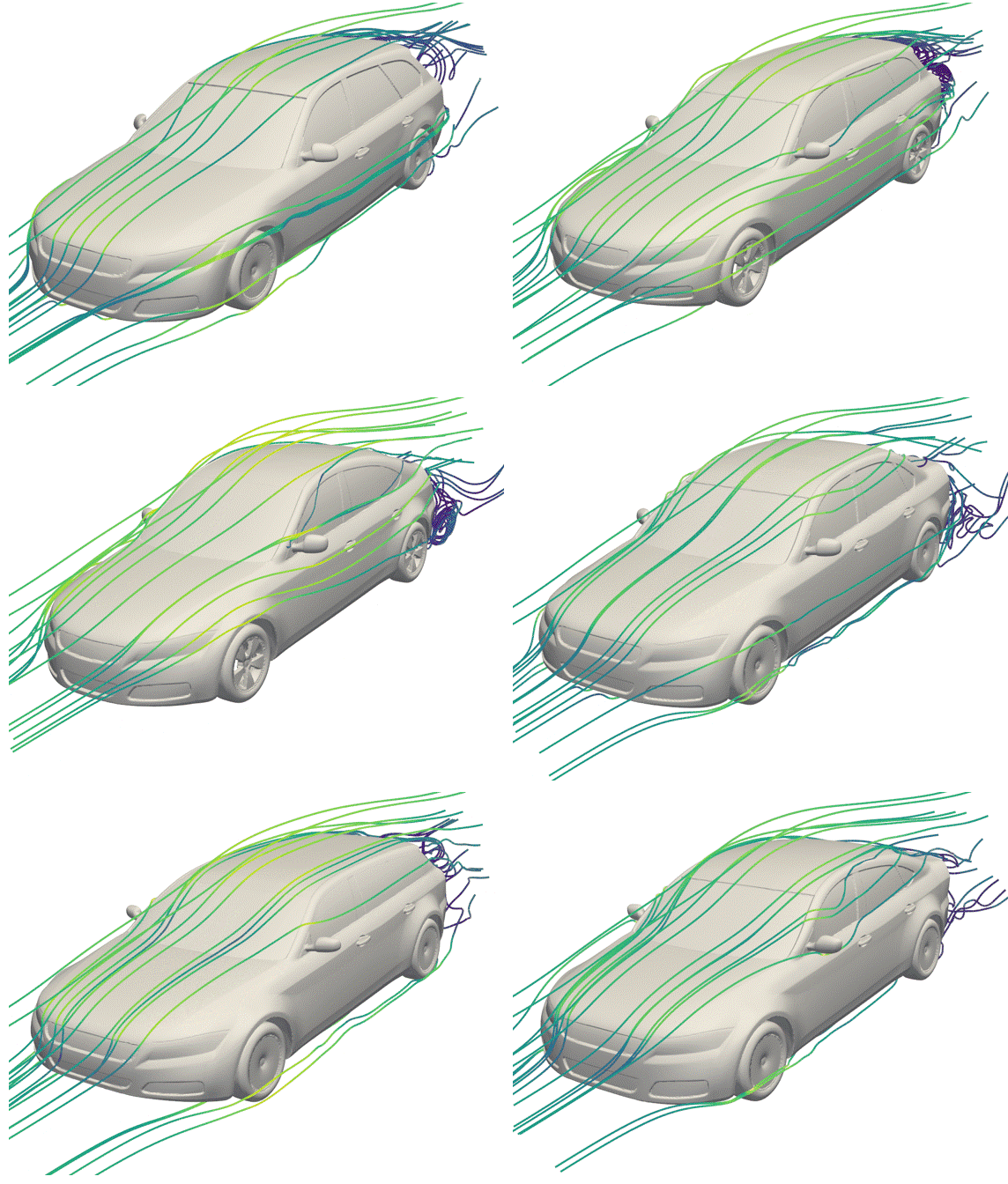
Every design ships as parametric data, full 3D volumetric fields (pressure, velocity, turbulence), surface fields (Cp, wall shear stress), streamlines, point clouds, meshes, aerodynamic coefficients, part annotations, photorealistic renderings, and sketches.
Volumetric & surface fields
Full 3D CFD fields plus pressure coefficient and wall-shear-stress distributions on every surface.
Part-level annotations
Detailed semantic labels for 29 car components — wheels, mirrors, doors — enabling segmentation, classification, and automated meshing.
29 class labelsSketch-to-design
Hand-drawn-style sketches (Canny & CLIPasso) and photorealistic renderings bridge conceptual creativity and computational design.
A community benchmark, not just a dataset
DrivAerNet++ ships with train/val/test splits and deep-learning baselines for surrogate modeling of drag, surface fields, and full volumetric flow. It powers the CarBench leaderboard and is integrated into NVIDIA PhysicsNeMo (FIGConvUNet, AeroGraphNet) and Baidu PaddleScience — and served as the basis of an IJCAI 2024 competition.
Citation
@inproceedings{NEURIPS2024_013cf29a,
  author    = {Elrefaie, Mohamed and Morar, Florin and Dai, Angela and Ahmed, Faez},
  booktitle = {Advances in Neural Information Processing Systems},
  title     = {DrivAerNet++: A Large-Scale Multimodal Car Dataset with
               Computational Fluid Dynamics Simulations and Deep Learning Benchmarks},
  volume    = {37},
  pages     = {499--536},
  year      = {2024}
}