Bringing the DrivAerNet recipe to aircraft
Blended wing body (BWB) configurations promise major fuel-efficiency gains, but designing them requires expensive CFD campaigns over unconventional geometry. BlendedNet applies the data-driven playbook pioneered in automotive aerodynamics to aircraft: a public dataset of parametrically generated BWB geometries with high-fidelity CFD, paired with a neural surrogate for rapid aerodynamic prediction.
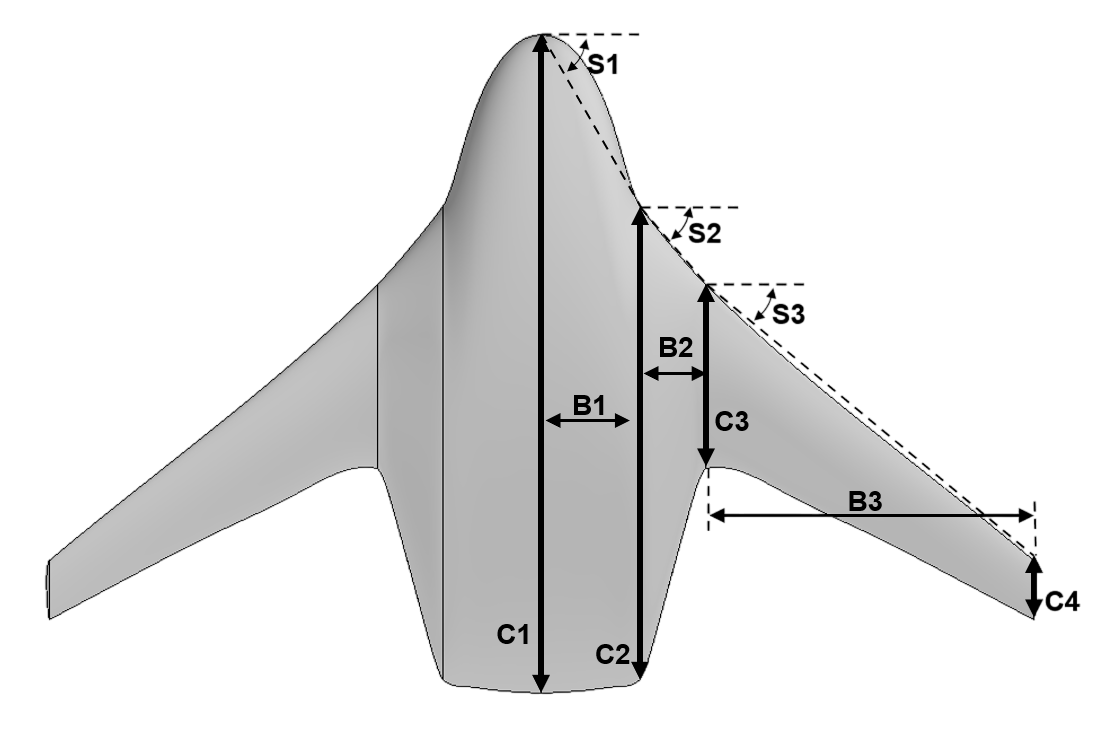
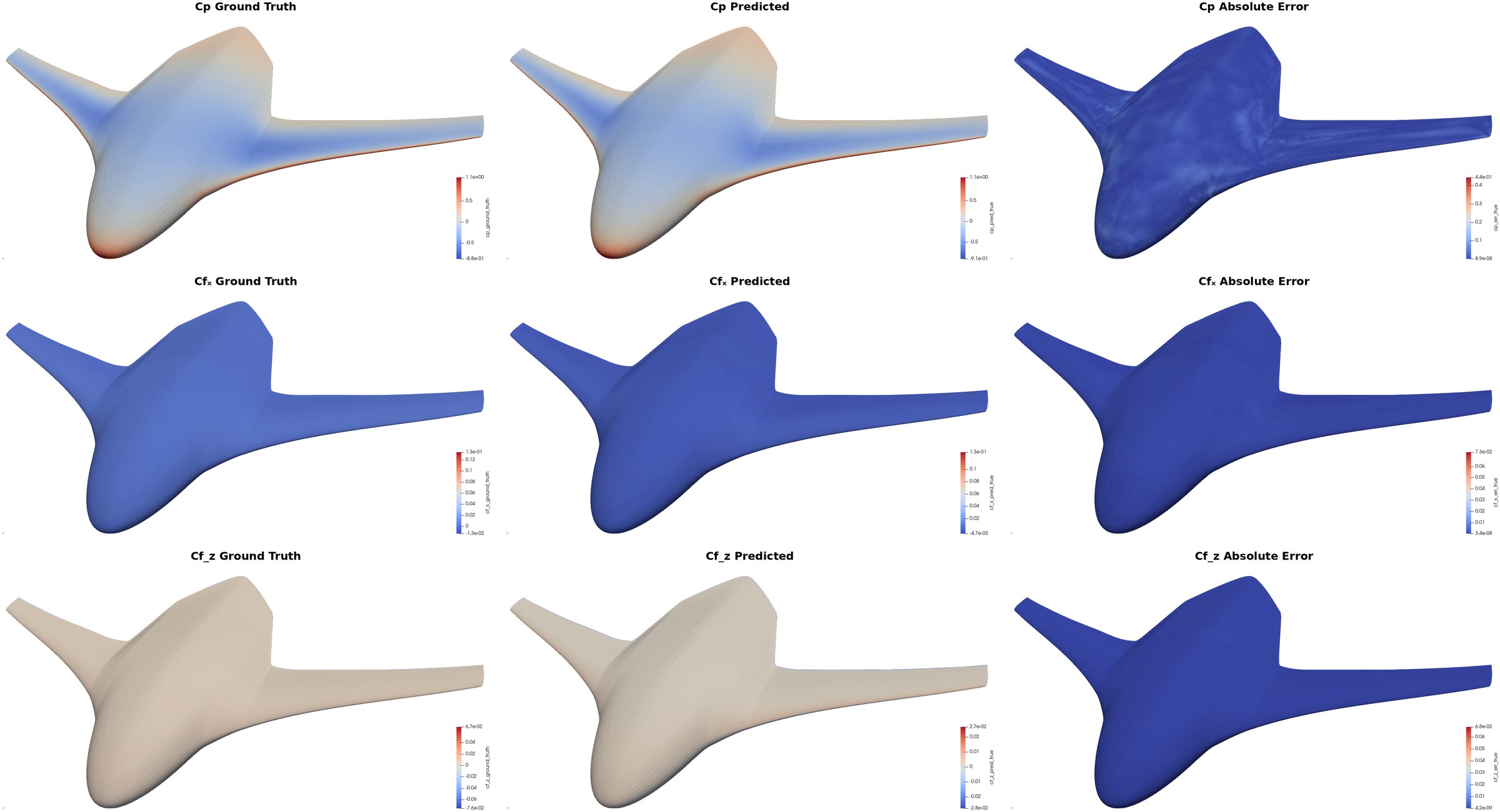
The numbers behind it: 999 BWB geometries, each simulated across roughly nine flight conditions, yielding 8,830 converged RANS cases with the Spalart–Allmaras turbulence model at 9–14 million cells apiece — with detailed pointwise surface quantities on every one. The surrogate is a two-stage pipeline: a permutation-invariant PointNet first recovers the geometric design parameters from a sampled surface point cloud, then a FiLM-conditioned network uses those parameters plus the flight condition to predict pointwise Cp, Cf,x, and Cf,z — turning a meshing-and-solving campaign into a forward pass.
What the paper delivers
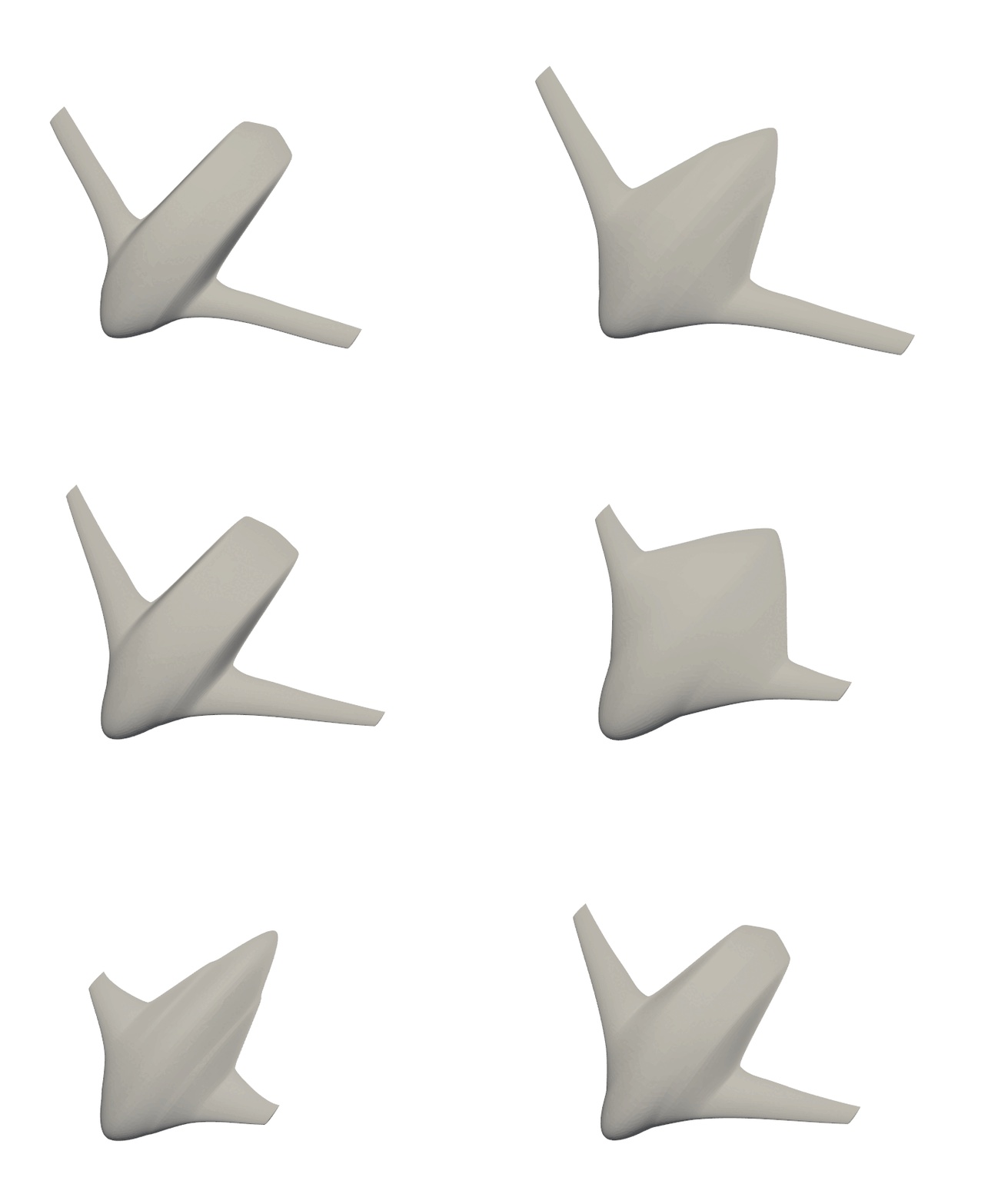
Public BWB dataset
Parametric blended-wing-body geometries with high-fidelity CFD — openly released on Harvard Dataverse for the aircraft-design community.
Aerodynamic surrogate
A learned model predicts aerodynamic performance directly from geometry, replacing hours of simulation in early-stage design.
Design-space coverage
Systematic parametric sampling spans the practically relevant BWB configuration space, enabling generalizable learning.
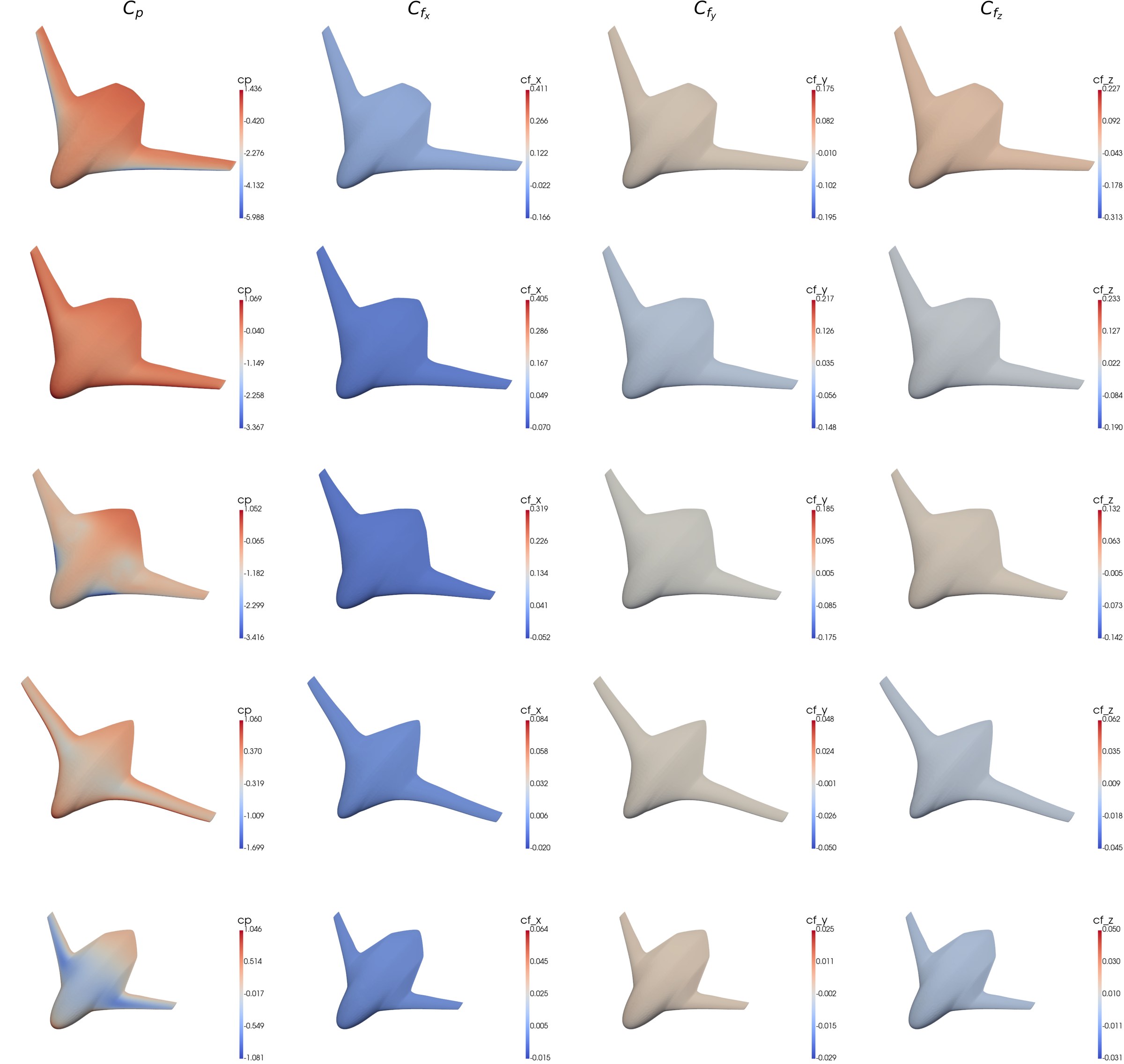
Surface fields the surrogate learns to reproduce
Each simulation carries full surface distributions — pressure coefficient and all three skin-friction components — across the design space. The neural surrogate learns these fields directly from geometry, matching CFD closely on unseen designs.
Citation
@proceedings{sung2025blendednet,
  author = {Sung, Nicholas and Spreizer, Steven and Elrefaie, Mohamed and
            Samuel, Kaira and Jones, Matthew C. and Ahmed, Faez},
  title  = {BlendedNet: A Blended Wing Body Aircraft Dataset and Surrogate
            Model for Aerodynamic Predictions},
  series = {IDETC-CIE},
  pages  = {V03BT03A049},
  year   = {2025}
}