Implicit neural fields meet automotive CFD
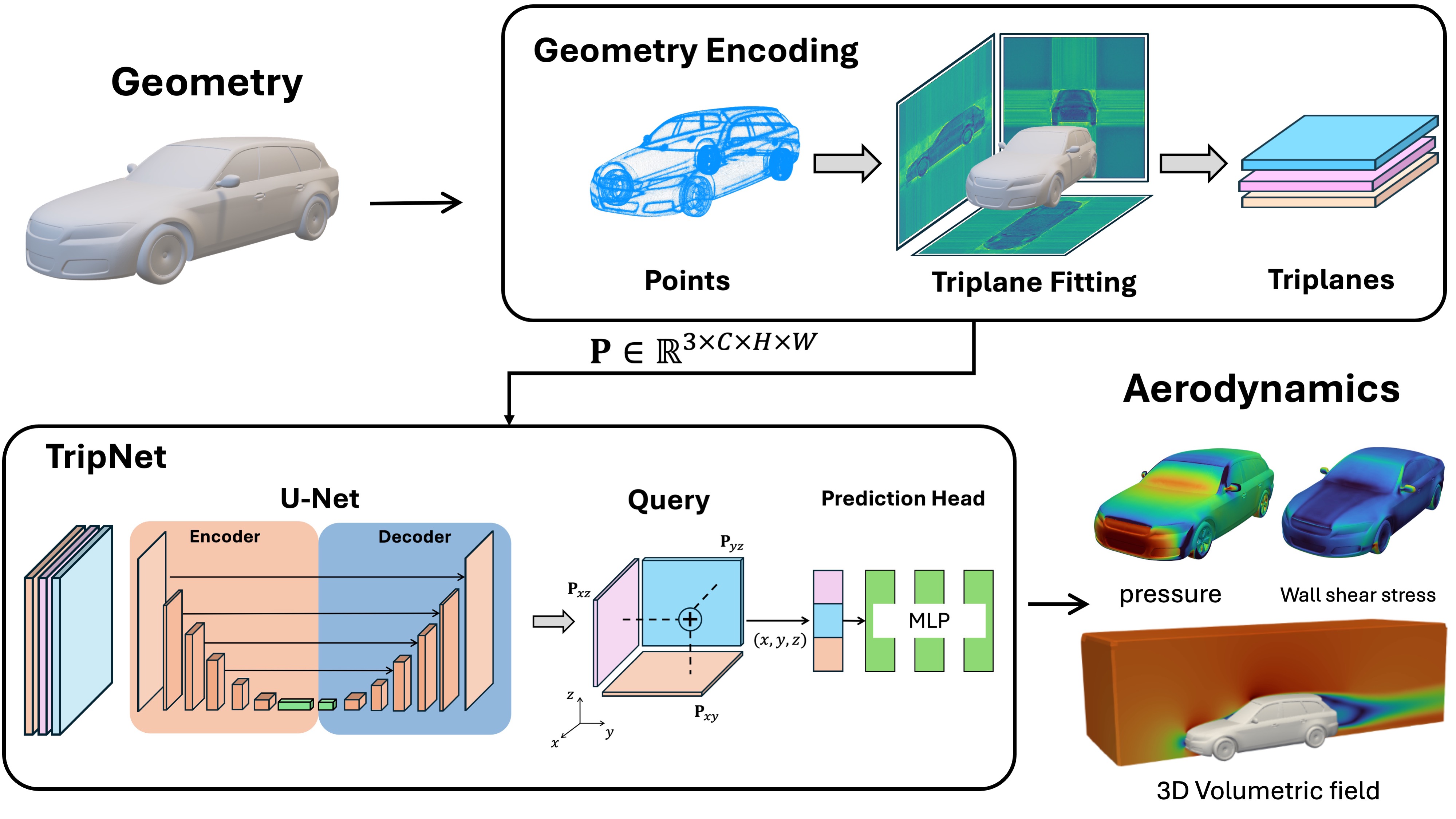
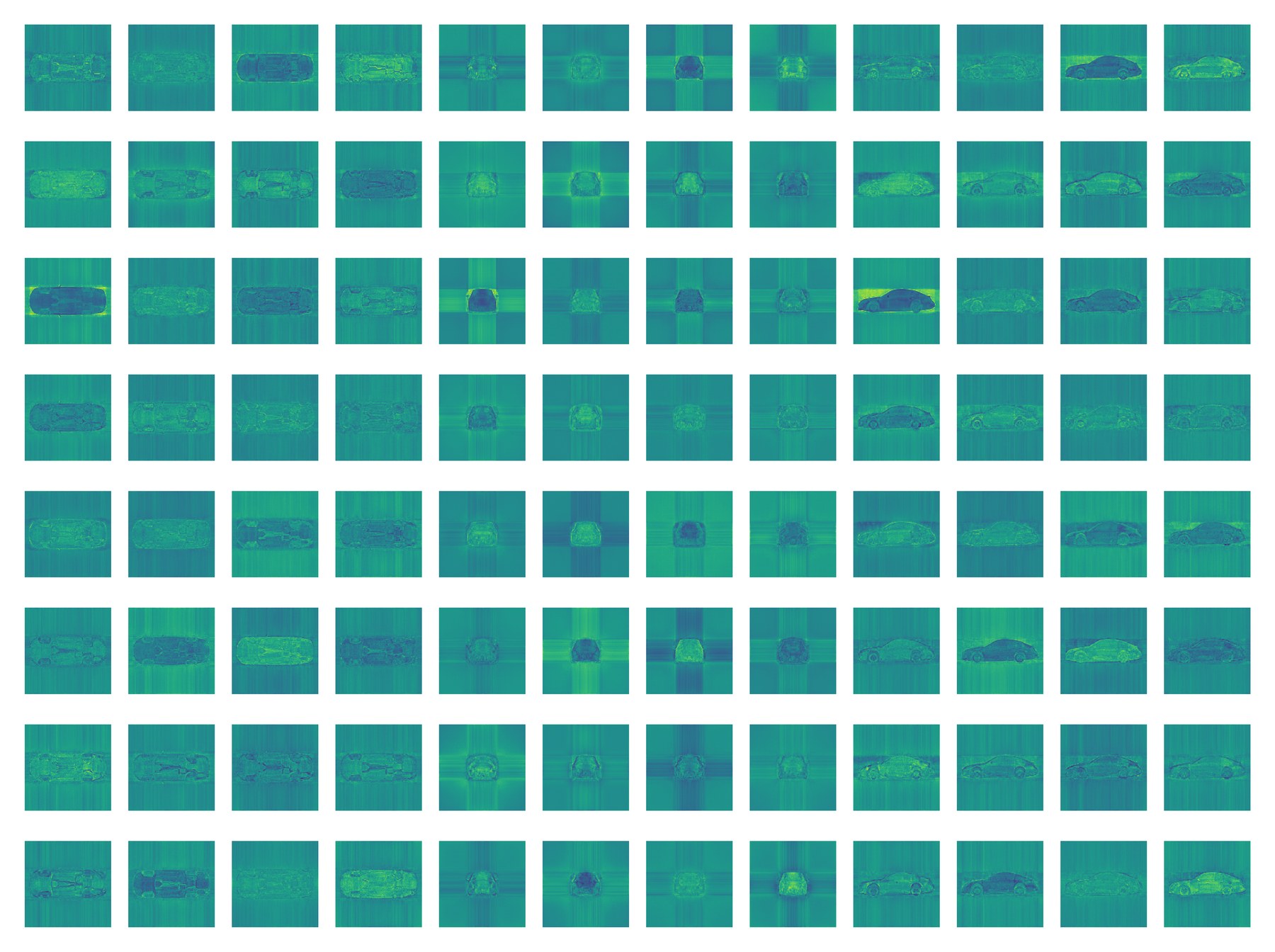
TripNet brings triplane representations — proven in neural rendering — to large-scale aerodynamic learning. Car geometry is encoded into three axis-aligned feature planes; any point in space can then be queried for aerodynamic quantities by interpolating plane features. The result is a continuous, resolution-independent surrogate for high-fidelity 3D car aerodynamics.
The motivating frustration: every existing 3D learning approach — point clouds, voxels, meshes, graphs — is chained to an explicit geometric representation whose memory cost grows with resolution. Industrial CFD meshes carry millions of nodes and cells, so those models are forced into aggressive downsampling, and accuracy degrades exactly where fidelity matters most. TripNet's triplanes break that link: the feature map has a fixed size regardless of mesh resolution, and any spatial location can be queried independently of mesh connectivity. That one architectural choice lets a single unified backbone deliver state-of-the-art drag coefficients, surface pressure fields, and full 3D flow predictions on both DrivAerNet and DrivAerNet++.
What the paper delivers
Resolution-independent queries
Fields are decoded per-coordinate, so predictions aren't tied to a fixed mesh or point-cloud resolution.
Unified surface & volume modeling
One representation serves drag coefficients, surface pressure fields, and volumetric flow — trained on DrivAerNet++ at full scale.
Efficiency at scale
Triplanes hold 3D structure at 2D memory cost, making high-fidelity learning tractable on the largest public car-aerodynamics dataset.
Closest to CFD, at any resolution
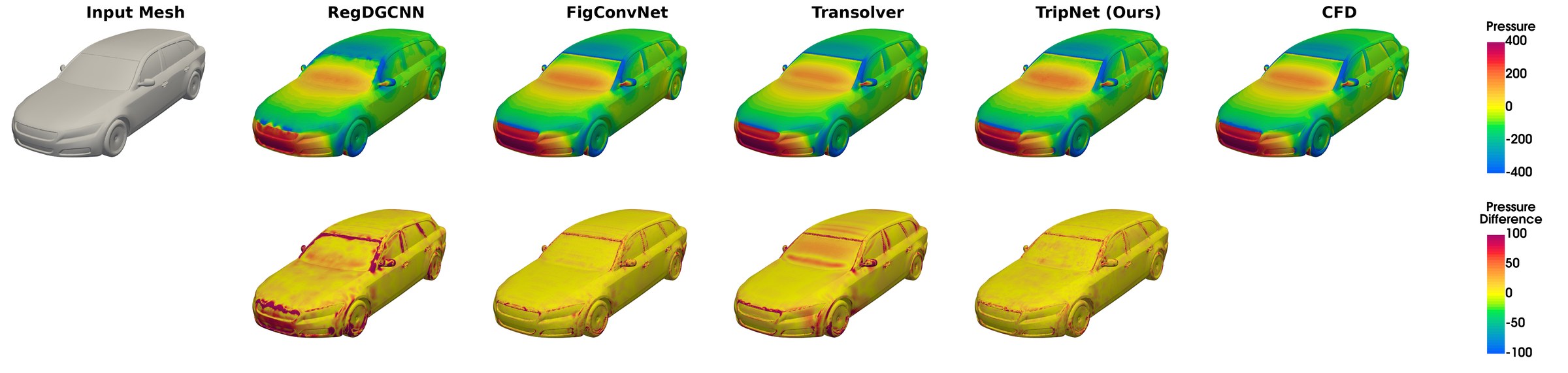
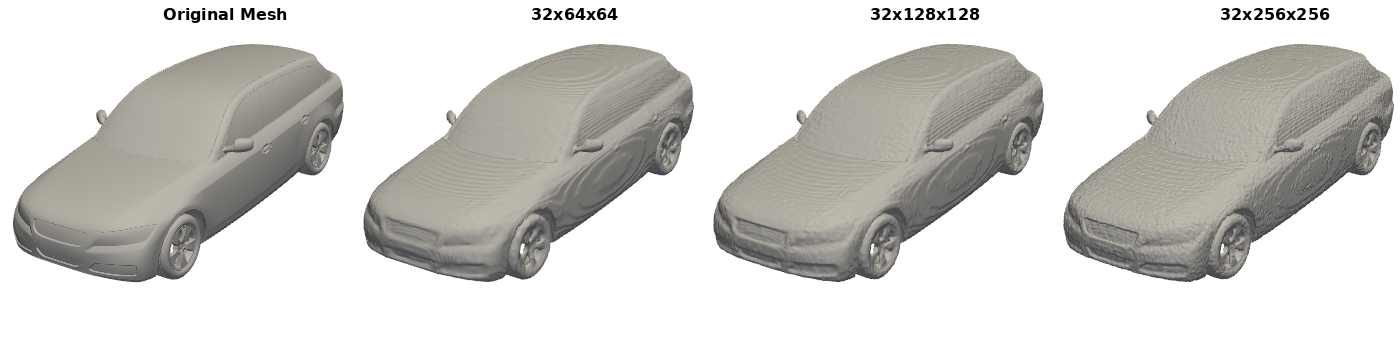
On DrivAerNet++ surface-pressure prediction, TripNet tracks the CFD ground truth more closely than RegDGCNN, FigConvNet, and Transolver — and because fields are decoded per coordinate, the same trained model reconstructs geometry and fields at whatever resolution the task demands.
Citation
@article{chen2026tripnet,
  title   = {TripNet: Learning Large-scale High-fidelity 3D Car Aerodynamics
             with Triplane Networks},
  author  = {Chen, Qian and Elrefaie, Mohamed and Dai, Angela and Ahmed, Faez},
  journal = {Physics of Fluids},
  year    = {2026},
  note    = {in press}
}